Noticeboard
Remembering Augustus John

At 7.00pm on Friday 28 February Dr D Ben Rees will give a talk entitled “Remembering the Welsh Artist Augustus John: in his home in Wales and in the City of Liverpool”.
Augustus John came from Tenby, and from his mother and the local art school he got the urge to paint. He and his talented sister Gwen John were encouraged to consider further training at the Slade School of Art. The lecturer suggests that the shy boy from Pembrokeshire became a real bohemian after a nasty accident when he jumped into the sea from a rock near his home and injured his brain. He resumed his education after months at home.
He came to Liverpool with his young wife in 1901, to lecture in the art school associated with the university. There he met the university librarian John Sampson, an authority on the Welsh Gypsies, and Augustus adopted the Gipsy way of life. He didn’t stay long in Liverpool, where David, his first son, was born, but he did make a great impression on the Celtic City. A pub on the university campus was named after him in 1967 and an exhibition of his work was staged last year.
Dr D Ben Rees, the Minister Emeritus of Capel Bethel, Liverpool, is well-known in the city as a local historian. He is giving this lecture as a foretaste of a festival to remember Augustus John and his friend John Sampson, which is going to be held in Liverpool on 17 June by the Merseyside Welsh Heritage Society.
Cwmulus are hosting this on-line talk, which is in Welsh, with an optional English translation. Registration at this link.
Rachel Barrett: Welsh Suffragette

At 7.00pm on Friday 24 March Mary Thorley will talk about Rachel Barrett: Welsh Suffragette and Radical Campaigner.
Rachel Barrett, who was born in Carmarthen in 1874, became one of the leading figures in the women’s suffrage movement. She was a talented orator and negotiator as well as being the co-editor of, and photographer for, “The Suffragette” magazine. She worked closely with Christabel Pankhurst and was imprisoned on a charge of conspiracy in 1913. As a hunger striker, she was force fed on many occasions. Radical in her politics, she was one of the most charismatic members of the Suffrage movement but her story is little known.
Mary Thorley, who is aiming to publish a book about Rachel’s life, is a retired headteacher and former head of Teacher Training at University of Wales, Trinity St Davids. She has a PhD in Welsh Women’s History.
Cwmulus are hosting this on-line talk. Details and registration at this link.
Y Sŵn

Not often that we’re invited to the pictures, but we’ve heard about this Welsh-interest film showing at the Cameo cinema at Tollcross (38 Home Street, Edinburgh EH3 9LZ) at 6:00pm on Wednesday 15 March. Details and tickets at this link.
Margaret Thatcher swept to power in 1979 with a manifesto that promised to establish a Welsh language television channel. Months into her premiership, she reneged on her promise and sparked protests in Wales. Against a backdrop of civil disobedience, the iconic politician Gwynfor Evans vows to starve to death unless the government changes its mind. One of the most colourful chapters of modern Welsh history told in an imaginative and unique style.
A feature film directed by Lee Haven Jones and starring Mark Lewis Jones (Gangs of London & Keeping Faith), Siân Reese-Williams (Hidden & Line of Duty) and Rhodri Evan (Hinterland).
Yn 1979, fe ddaeth Margaret Thatcher i rym gyda maniffesto ag addawodd sefydliad sianel deledu yn y Gymraeg. Ar ôl ychydig fisoedd mewn grym, fe aeth hi yn ôl ar ei gair a sbarduno protestiadau eang ar draws Cymru. Gydag ymwrthedd sifil yn bygwth, mae’r gwleidydd eiconig Gwynfor Evans yn ymrwymo i lwgu i farwolaeth os nad bod y llwyodraeth yn newid ei meddwl. Un o benodau mwyaf lliwgar hanes Cymru wedi ei hadrodd mewn ffordd greadigol ac unigryw.
Ffilm wedi’w gyfarwyddo gan Lee Haven Jones gyda Mark Lewis Jones (Gangs of London & Keeping Faith), Siân Reese-Williams (Hidden & Line of Duty) a Rhodri Evan (Hinterland).
Amgueddfa Syr Henry Jones

At 7.00pm on Friday 24 February Ann Vaughan will talk about the Sir Henry Jones Museum.
The Museum is in the centre of Llangernyw on the main A548 road from Abergele to Llanrwst. The museum was two houses long ago, Henry Jones’s family on the left and his grandparents on the right. On the left is the bootmaker’s workshop and on the right is the kitchen. The Museum was opened in 1934 by the former prime minister David Lloyd George.
Henry Jones was born in 1852 and came from a poor background. His father was a bootmaker and Henry would help him in the workshop. He did not like Llangernyw church school because of the Welsh Not and children being punished. He was given books by Mrs Roxburgh to read and he educated himself. He was a very capable boy, winning the Penny Readings and singing. He went to Pandy Tudur school to John Price the principal and the farmhand. He won a scholarship to go to Normal College, Bangor then he taught in South Wales and lectured in Aberystwyth and Bangor before moving to Glasgow University. Henry Jones secured and established secondary schools in Wales fourteen years ahead of England. A very progressive man in that era.
David Lloyd George and Henry Jones were contemporaries. Both were from poor backgrounds, both worked in the bootmakers’ workshops. Lloyd George then helped Henry Jones when his son Elias Henry Jones was a First World War prisoner in Yozgad, Turkey. Elias used to send postcards home to his father, mother, and wife with hidden messages in them and those were then used to help the soldiers. Also Lloyd George, Henry Jones, and John Williams, Brynsiencyn were friends because they recruited young men to go and fight in the war.
Cwmulus are hosting this on-line talk, which is available both in Welsh and with an English translation. Details and registration at this link.
Sing along with Cor Meibion Taf!
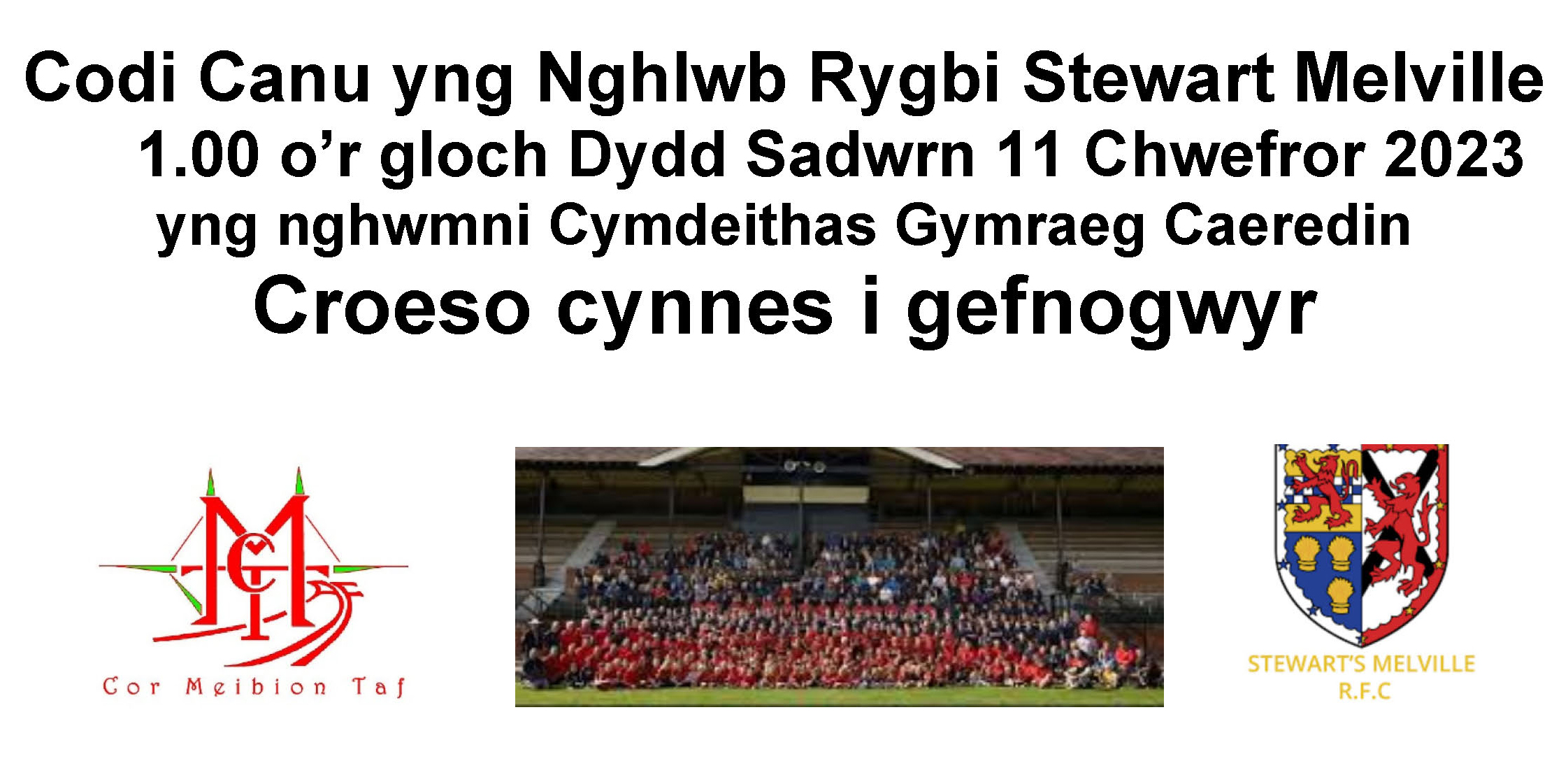
Cor Meibion Taf Male Voice Choir extend a warm welcome to rugby supporters and all others to their sing-along at Stewarts Melville Rugby Club (523 Ferry Road, Edinburgh EH5 2DW) at 1:00pm on Saturday 11 February. The choir will have been performing at Mount Stewart House on Bute the previous day as part of their 2023 Scottish tour.